“The thread is too fine for you to see it. You can only feel it… If ever you find yourself in any danger, you must lay your finger upon the thread, and follow the thread wherever it leads you.”
— George MacDonald, The Princess and the Goblin
A note to you, the student
For the next six weeks, you are going to follow one person through Of Mice and Men. Not the whole novel — one person. You will watch what they do, what they say, what they wish for, and what happens to them. Each week, you will add one small piece to a portrait of this person.
You will also do one piece of real-world attention work alongside your reading — a Relation Study — chosen in Week One and carried all summer. The character study lives in the book; the Relation Study lives just outside it. Together, they hold the world Steinbeck wrote into.
By Week Six, you will have followed your character all the way through the book, met two philosophers who asked similar questions almost a century later, written a haiku that distills the person to seventeen syllables, and built something real from the world the novel describes. What you have at the end is your own — a record of one sustained act of attention.
How the work builds
The strip across the top of each page shows where you are in the arc. It begins pale in Week One and deepens to a deep sage by Week Six. Light grows into weight; noticing grows into knowing.
Working on paper? Print this guide — each task has a box to write your work in by hand.
Choose your thread
This week, you make two choices. Both will shape everything you do this summer. Take your time with them.
Read Chapters 1 and 2. As you read, pay attention to the people. There are more of them than you would think for such a short book — George, Lennie, Candy, the boss, Curley, Curley's wife, Slim, Carlson, and Crooks, whom you will meet later. One of them will pull at you more than the others. That is your character.
Write three things:
- The name of the character you will follow this summer.
- One sentence about why you chose them — what made you notice this person.
- The first quote of theirs that caught your ear. Copy it exactly, with the page number.
My character is…
I chose them because…
The first quote that caught my ear (with page): …
Your second choice — a Relation Study
Alongside the character work, you will carry one piece of real-world attention through the summer. Charlotte Mason called education the Science of Relations — her conviction that each of us is born already connected, by living ties, to a vast number of things and thoughts, and that real learning is the widening and deepening of those ties. A Relation Study is exactly that: not research from a distance, but one sustained encounter with the world the book grew out of, made by your own hand. It puts you inside the novel's world instead of leaving you outside looking in.
Read the three studies below. Choose the one that calls to you. Each one is about four hours of work, spread across the six weeks — small bits each week, not a sprint at the end.
Re-read the opening paragraph of Chapter 1 aloud. Then begin a map of the place Steinbeck describes — not a geographic map, but his: the pool, the path, the Gabilan Mountains, the sycamores, the worn earth. Add to it across the weeks as new places appear — the bunkhouse, the barn, Crooks's room. Pencil in the words Steinbeck uses for parts of the land. In a corner of the map, write a few sentences about what kind of place this is — not how it looks, but how it feels. Because you have all summer, make it beautiful: hand-drawn, with color and texture, illustrated landmarks, a compass rose, hand-lettered labels, a title, and a small legend. Mark where the key moments happen as you read — a naturalist's map, not a road atlas.
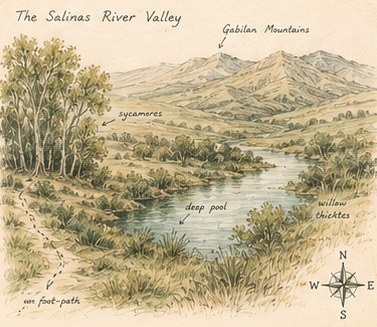
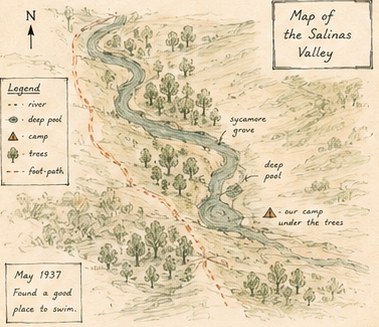
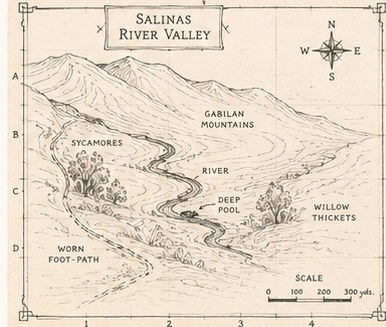
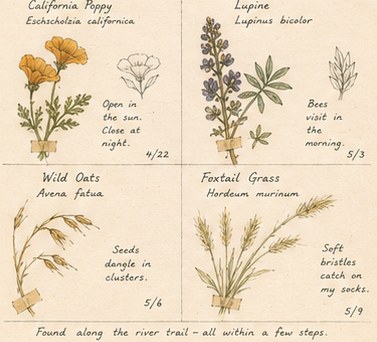
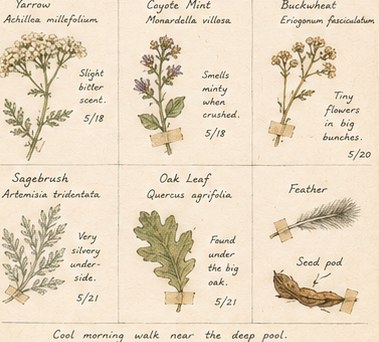
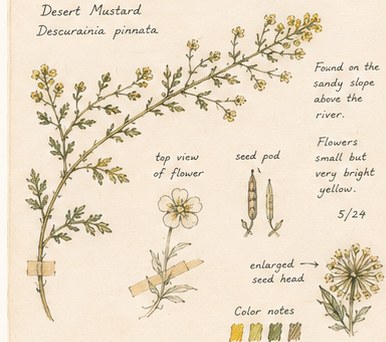
Give this about forty minutes each week — it is a study, not a craft. Walk somewhere green, and each time choose one or two plants that catch your attention. Pick small pieces with care and press them between paper, under a heavy book, for three or four days. But the pressing is only the beginning: the real work is the looking and the writing. For each specimen, sit with it and build a full field entry — its common name and, where you can find it, its scientific name; where and when you found it; a close pencil sketch; and several sentences of careful description, written the slow, deliberate way Steinbeck wrote, choosing every word on purpose. Then reach for the book: name what this plant calls up — a moment, a mood, a character — and say why. By summer's end you will have a page of pressed specimens, and, more than that, a page of patient attention: a naturalist's record made by your own hand and eye.
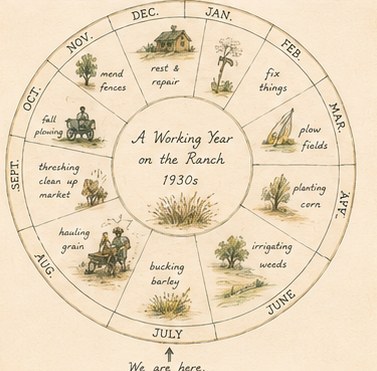
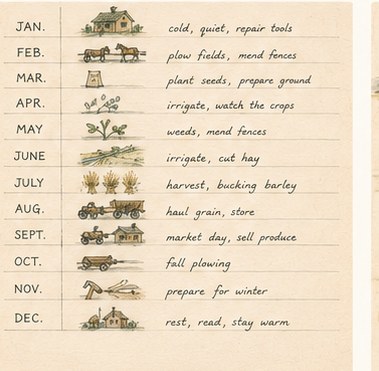
Spend a little time each week with one real source about migrant ranch labor in 1930s California — the Library of Congress Farm Security Administration photo collection, an oral history, or a chapter of Steinbeck's The Harvest Gypsies. Across the summer, build a calendar of the working year: twelve months, what a ranch hand would be doing in each one — the planting, the harvest, the bucking of barley, the lean stretches in between. Mark where in the year the novella happens. Around the edges, write notes about what surprised you, what you understand differently now.
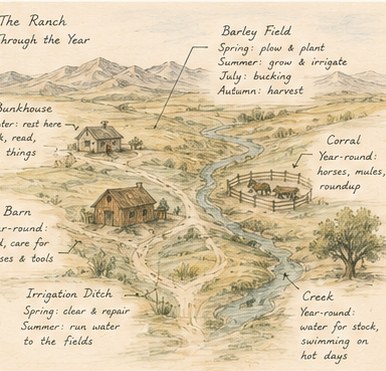
Write down which Relation Study you have chosen. From here on, you will work on it a little each week. Begin this week by gathering what you need — the paper, the book you'll press plants under, the bookmarked source, the first walk.
The Relation Study I chose is…
To begin, this week I will gather…
A letter from your character
This week the work grows quieter and deeper. You stop describing your character from the outside and step inside their voice.
Read Chapter 3. Stay with your character. Notice what they do when no one is watching, and what they do when someone is watching. The difference is part of who they are.
Write a letter from your character to someone they love or miss or wish they could speak to — a brother, a sister, a parent, a friend who is no longer with them. The person on the other end doesn't have to be in the book.
The letter should sound like your character would sound if they sat down to write it. Stay in their words. Try to write what they would say, not what you would say about them.
Dear ________________,
And your Relation Study
Add one small piece this week — one section of the map, one pressed plant, one source-and-note pair on the calendar. Forty minutes of careful work, no more.
Freedom and the choices we make
This week, look at what your character can and cannot choose — and what they do with the choices they have.
Read Chapters 4 and 5. The world of the ranch is harder this week. Watch your character in it. Notice the moments where the world gives them something, and the moments where it takes something away.
Where in this week's reading does your character have a real choice? Where do they have almost none? When they do choose, what do they choose — and what does that choice cost them?
Use one specific quote from this week's reading to anchor what you see.
Where my character has a real choice: …
Where they have almost none: …
What they choose — and what it costs: …
A quote that anchors this (with page): …
And your Relation Study
Another forty minutes. Add to the map, press a plant, study a source. The slow building matters.
Rewrite the scene
This week, you take the boldest step of the summer — you write inside the book itself.
Read Chapter 6. This is the end of the book. Your character is somewhere in this chapter, even if they are not in the room. Where are they? What are they doing? What do they know?
Choose one moment from Chapter 6 — a small scene, half a page in the book. Rewrite it, but from inside your character's head. What are they seeing, hearing, thinking, holding back? If your character is not in the scene Steinbeck wrote, invent where they are at that exact moment, and write what is happening there.
Stay faithful to who your character has been across the whole book. Their voice now should sound like the voice you have come to know.
The moment I'm rewriting (Chapter 6): …
And your Relation Study
Forty minutes. Each week you have added a little — by now, the shape of what you are making is beginning to show.
A haiku for your character
You have followed this person all summer. This week, you distill them.
A haiku is three lines and seventeen syllables — a Japanese tradition for catching the essence of one thing in very few words. Traditionally a haiku catches a single moment, often in nature. This week, you will catch a single truth about a person.
The form
Three lines, in 5 — 7 — 5 syllables. No title, no rhyme, no extra words. Just three lines that hold one true thing.
Slim does not speak first.
The room waits. When he answers,
the room believes him.
Notice what the haiku does — and what it refuses to do. It does not describe Slim. It shows the room's response to him, and trusts you to feel his weight from that. A haiku about a person often works best when it isn't about the person — it's about the small space they make in the world.
Try more than one. Your third draft will almost certainly be better than your first. Write three or four and choose the one that says something true.
Draft one…
Draft two…
Draft three…
The one I'll keep…
And the philosophers join us
This week, you also meet two thinkers who were writing at almost the same time as Steinbeck, asking the same hard questions. Albert Camus asked: what makes a life meaningful when the world doesn't seem to care? Jean-Paul Sartre asked: what does it mean to be free, and what do we do with that freedom? You will find them in the Existentialist Lens reading.
Hold your character beside one of their questions as you write. Don't try to explain — just let the question be in the room with you.
And your Relation Study
One more forty-minute session this week. You are nearly done.
The Relation Study comes home
This is the arrival. The thread you have been following all summer comes to rest in the work of your hands.
This week, finish the Relation Study you chose in Week One. Whatever is left to do — the last section of the map, the final plants, the closing notes on the calendar — bring it to completion. Spend the last hour or so making it whole: the arrangement, the labeling, the writing-around-the-edges.
When the Relation Study is complete, write a short reflection to go with it. Not a description — an honest few sentences about what you saw differently after making it, or how this work sits beside the character you followed all summer.
After making my Relation Study, I saw differently that…
Beside the character I followed all summer, this work…
And the gathering
Put together everything you have written this summer — the character notes from Week One, the letter, the freedom paragraph, the scene rewrite, the haiku, the Relation Study and its reflection. All of it is your Capstone. Hold it together with a clip, in a folder, in a small notebook, in any way that feels right.
Our final Zoom class is where you will share your Relation Study with the rest of the class. Bring it to camera. Tell us what you made, what you learned in making it, and how it sits beside the character you followed.
If you can't attend the live Zoom, submit clear photographs of your Relation Study (more than one if needed) and a short written version of what you would have said. Upload everything to Google Classroom.
Submit your full Capstone to Google Classroom: photographs of your Relation Study, scans or photos of your written pieces from each week, and your final reflection. The shape of the work is the same; you bring it together at your own pace.
What you have made is small, and it is yours, and it is real.
That is the whole point.