The World of the Novel
Compare your narration
After you've written your own narration on paper, read these two and hold yours beside them. This is for your own noticing — nothing to submit.
Strong Example Narration ›
Two men walk to a ranch together, and the big one, Lennie, doesn't know his own strength, so George does the thinking for both of them. By the pool George gets angry about the dead mouse Lennie keeps petting — but he softens when Lennie begs for the story about their farm, because the rabbits get him every time. At the ranch nobody makes them welcome: the boss is suspicious, Curley wants a fight the minute he sees Lennie, and Curley's wife keeps appearing in doorways. So George makes Lennie memorize one thing — if anything goes wrong, come back to this pool and hide in the brush.
What makes it strong: it's in her own voice, not an imitation of Steinbeck — and it's only four sentences. She kept what mattered (the mouse, the dream speech, "hide in the brush") and let everything else go. She's already noticing a pattern: "he softens when Lennie begs for the story." A narration doesn't have to be long; it has to be hers.
Weak Example Narration ›
The book is about two guys named George and Lennie who are going to a ranch to work. Lennie is big and strong. George is short. They walk along a road and stop at a river. Then they go to the ranch and there are a lot of people there. One guy is named Candy and he has a dog. The boss doesn't like them at first. Curley is mean. Curley's wife comes in. That's what happens in Chapter 1 and Chapter 2.
What's weak about it: it reads like a Wikipedia summary, not a narration — "the book is about" is a tell. Everything gets one flat sentence, so nothing has weight. There's no voice. It misses the dream speech entirely, one of the book's most important moments. And it ends by announcing itself — a narration should just stop.
This is where the week opens outward — toward other thinkers, other art, and the help you need to do your best work.
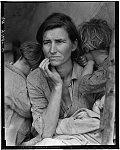
Migrant Mother
Dorothea Lange, 1936 — the same year, the same California as this novel. Look for sixty full seconds before you read anything about it. Then hold it beside Chapter 1.
The Existentialist Lens
A short companion reading for the ideas running underneath the novel — with an honors track for those who want to go deeper. Read it after the chapters, before you write the Capstone.
Open the Lens ReadingFollowing the Thread
All summer, you'll follow one character through Of Mice and Men — reading the novel beside Camus and Sartre, and building a small portrait one step at a time. This week: choose your character and take Step One.
Print the Capstone CompanionWhen your work for this week is finished, turn it in on Google Classroom.
Turn in on Google Classroom